In a groundbreaking announcement, the King of Bhutan has revealed plans for the Mindfulness City, a visionary project crafted by renowned architecture firms Bjarke Ingels Group (BIG), Arup, and Cistri. Rooted in Bhutanese culture and inspired by the country’s Gross National Happiness (GNH) index, this project aims to establish the Gelephu Special Administration Region (SAR) as a beacon of economic growth. The masterplan, realized by BIG’s Landscape and Urban Design Team, integrates green technology, education, and infrastructure, creating a city that connects South Asia with Southeast Asia.

Set against the breathtaking backdrop of Bhutan’s mountains, forests, and rivers, the Mindfulness City seeks to amplify the country’s biodiversity by weaving together interconnected ecosystems and neighborhoods. The city’s design, resembling ribbonlike paddy fields, will cascade down from the hills to the valley, creating a harmonious blend of urban and natural terrains. The project emphasizes density increases from rural highlands to urban lowlands, ensuring a seamless integration with the existing landscape.

The visionary concept envisions 11 distinct neighborhoods, each following the principles of the Mandala, organized around central public spaces. Inspired by Bhutanese culture, the city’s design aims to enhance ecological systems, connect people with nature, and exemplify sustainable human presence on Earth. To safeguard against monsoon flooding, paddy fields will be established along rivers, doubling as biodiversity corridors and preserving wildlife migration routes.


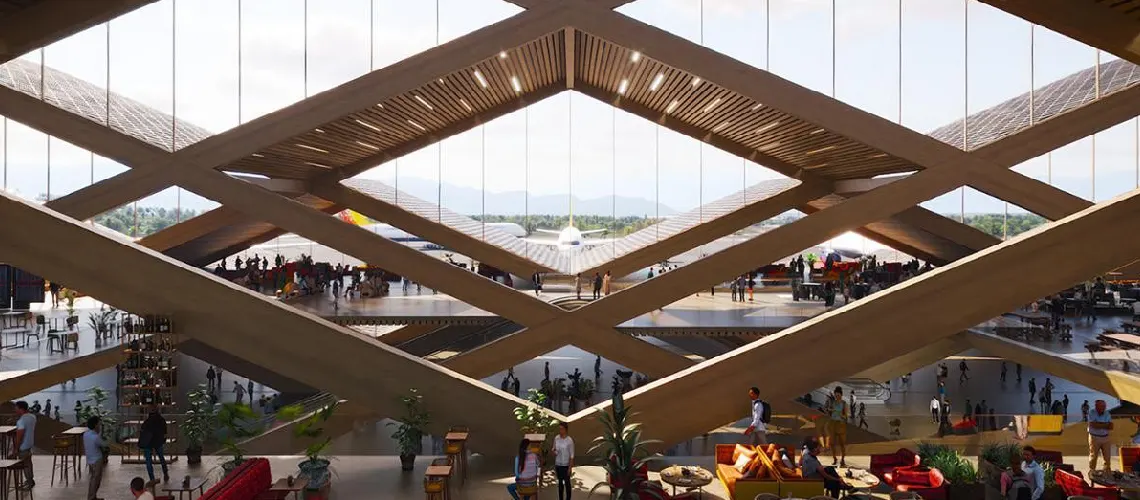
The Mindfulness City will feature ‘inhabitable bridges’ tying together neighborhoods, housing key destinations like the airport, a spiritual center, a healthcare facility, a university, and more. These bridges, tailored to the nine GNH domains, will be integral to transportation infrastructure and civic and cultural facilities, offering a unique blend of functionality and aesthetics.


Local materials such as wood, stone, and bamboo will be used in construction, reflecting Bhutanese vernacular motifs. The project aligns with Bhutan’s commitment to Gross National Happiness, focusing on psychological well-being, health, education, living standards, ecological diversity, good governance, cultural diversity, and community vitality.